There's no need to speak. You must only...concentrate and recall all your past life. When a man thinks of the past, he becomes kinder.
Play Trailer
RELEASE
1979-05-25
BUGET
$0.1M
LENGTH
162 min
Description
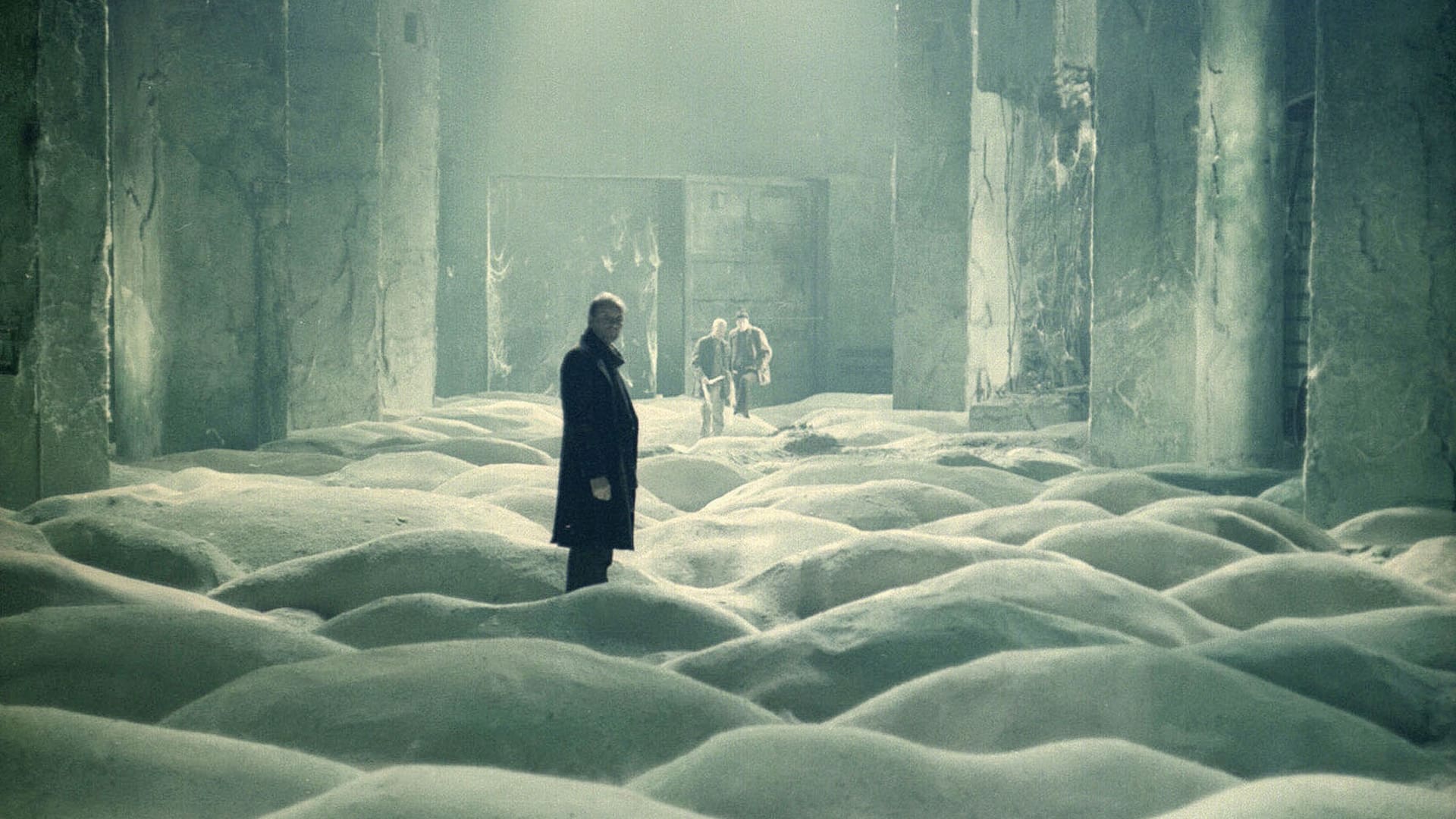
Near a gray and unnamed city is the Zone, a place guarded by barbed wire and soldiers, and where the normal laws of physics are victim to frequent anomalies. A stalker guides two men into the Zone, specifically to an area in which deep-seated desires are granted.
This movie is like an onion, has multiple layers. To understand it, you have to be very careful and pacient. You have to focus on movie and not doing anything else while you watch it, because if you don't, you won't understand it.
This really is the cinematic equivalent of "be careful for you wish for". Two characters - a teacher and a professor, seek out a "stalker" who can lead them through the maze of challenges that culminates in an heavily restricted area know as the zone. Why? Rumour has it, that when in that zone you may make wishes that will immediately come true. What is this place? Is it real, imaginary, alien, all of these - or it is all just a cerebral hallucination of a place that, like El Dorado, we imagine to be where all of our problems can go away, be solved, eradicated. It is loosely based on the Strugatsky brothers early seventies sci-fi novel "Roadside Picnic" but it's fair to say that Andrei Tarkovsky opens up the more linear aspects of their story leaving us with a much less defined and more intangible series of threads as these men undergo significant travails to get to a place - that frequently resembles what I imagine Chernobyl to have look like after it exploded. As with so many aspects of human aspiration, the narrative is all about what I would call the chase - the journey or the means - without the characters ever really knowing what it is they will truly want if they do actually achieve their goal. Again, the director provides us with lots of bits of this mischievous, sometimes perilous and thought-provoking Rubik's cube - but it is incomplete. We know it is always going to be. We, the audience, have to bring a bit of ourselves to this particular party. There is a denouement - three men in a room. One (Nikolai Grinko) with a hefty nuclear bomb that he believes may offer a solution; another (Anatoly Solonitsyn) who's darkest id well outmanoeuvres his ostensibly well meaning reasons for being there and of course the stalker himself (Alexander Kaidanovsky). This production is deliberately, and effectively slowly paced. The dialogue can be intense, their frustrations and dreams well encapsulated; but it can also be sparing - there are plenty of periods of protracted silences from them all. Accompanied by an eerily complimentary score from Eduard Artemyev, we are left with an experience rather than just a film. I saw it on a big screen, and if you can I'd recommend that. It helps you to stay focused on the complex and quirky plot whilst bringing out the finely crafted bleakness, and hope, of the photography.
Filipe Manuel Neto
@FilipeManuelNeto
More style than content.
This was my first contact with the cinematographic work of Andrei Tarkovsky, a Soviet filmmaker who would end his career outside his native country when he fell into disgrace for allegedly spending too much money on films that were not worthy of the expense. A regrettable attitude, but typical of countries that prefer to spend money on missiles than on support for culture and education, especially after considering how dangerous and insubmissive can be a cultured population capable of thinking without anyone from a party saying what It's the right thing.
This is not, however, an ordinary Soviet film, loaded with subliminal messages, more or less direct, demonizing the rich and praising the effort and dignity of workers. On the contrary. Tarkovsky takes us to a desolate world, apparently hostage to repressive authority. There is nothing beautiful there. And there is a space where no one can go, called the Zone, in which there is, supposedly, a room that makes the dreams of those who arrive there come true. However, the difficulty is immense.
Being a Russian film, it is obviously a huge, dull, heavy film. Let's face it, it's to be expected: Russians like big things. Big countries, big armies, gigantic cannons and missiles. Russia cultivates that taste for gigantism, of which the Tsar-Pushka is a prominent symbol. It's difficult to see everything, the way the film develops, in deliberate slowness, is exhausting and dark. The cinematography is partly in sepia (color comes later, and the colors are directly associated with entering the prohibited area) and has been well crafted, as have the sets and filming locations. The rest simply doesn't matter: it's a film that is almost silent, and that puts style above substance.
CarsonTrent
@CarsonTrent
Metaphysical themes explored in Stalker
The three main characters are Archetypes: Writer, Professor (scientist) and Stalker (seeker).
One is the Stalker which is the seeker, a man searching for redemption which has faith ( Faith is an unreserved opening of one's mind to whatever the truth turns out to be / opposed to belief which is opening up to the truth as long as it fits with preconceived ideas and wishes). Stalker lives in a polluted industrial town which represents technological development of Man, with its positive and negative aspects, such as his paraplegic daughter which may have been born this way due to pollution, but may also have gained some other powers (issues nevertheless irrelevant to the fundamental nature of being). He feels in prison everywhere, because he is seeking for meaning. He cannot settle for the mundane. That's why he fights with his wife, but also why she chose him (as stated by her at the end). She will never be bored with such a man.
The other is the professor (scientist), a man looking to explain reality in scientific language (scientific language is an abstraction. This sort of man is a believer, because he has developed abstract ideas and will try to explain the World using his abstract language. If he fails he will become forceful resorting to violence). Soft versus hard, as explained in the movie may apply to abstract language, too. Soft is adaptable like a new born, while hard is death.
The third one is the writer, the man trying to aquire and then to convey wisdom (This is a man of faith but also one which is most preocupied with his own Ego. His role in life, immortality, ultimate wisdom and his legacy. This is why when confronted with "The Room" - representing wisdom, he hesitates in fear that his subconscious desires may be unveiled. These desires may be less noble than he likes to declare).
All three represent MAN and ALL that can be ultimately done in this fragile and transitory life: observe, interpret, document, teach and have faith that it all has meaning.
The ever morphing landscape of the "Zone" represents LIFE / REALITY (which does NOT contain movement, but IS movement itself). The discussions the 3 main characters have are like an interior monologue. If they were all in fact one person. And they are. Because the movie is an allegory.
The testing for traps and throwing of metal nuts tied to strips of cloth represent human superstitions and beliefs that one can have some control over the environment and preserve personal safety during one's passage through life.
The essence of monotheistic belief systems is also explored. Christ as symbolic martyr for our collective sins. The myths we create to justify our actions supposedly sanctioned by divinity and whether we are ready to leave them behind thus embracing free will which comes with full responsibility. Transcending what Freud called the Super-Ego as part of the psychic apparatus.
The former stalker "Porcupine" represents gluttony as he reportedly led his brother to death in the "Zone" and after visiting the Room came into possession of a large sum of money fulfilling his secret desire for wealth. He subsequently committed suicide after realizing that material riches are ultimately empty. The Room (wisdom) is lethal to those who seek it for negative reasons.
What happens throughout the movie is that slowly all three masks fall and reveal their inner struggles. They all represent MAN and his ultimate struggles. "The Room" represents ultimate wisdom which is that all three men are masks of the EGO which is ultimately an illusion.
The movie is a bit long, but I think this length is meant to allow the impression of the dialogs separated by topic which lead to the understanding of the message by the viewer without topics overlapping. It's impressive how powerful visually the movie is, especially considering the simplicity of devices employed (but within lays the artistry of the author).
I found that most themes in Stalker can be found in all World religions, but ALL of them can be found in Buddhist thought. Especially the one about abstract language which creates an illusory World in our minds (the EGO), made up of symbols and words. This creates an artificial sense of separation between our minds and Reality which we subsequently perceive to be outside, separate from "ourselves".
Final thought: the movie came out at the height of Communist rule in Russia. This shows that the deepest metaphysical searches and struggles of MAN are unrelated to the mundane life (the basic existential needs), and that these themes transcend politics and can even be discussed "openly" by those who are seeking them. Especially through the visual medium closest in its nature to the transience of life (along with music), which is film.